You review 3% of your calls. Sentinel reviews all of them.
Every collections call, transcribed in the languages it was actually spoken in and scored against your compliance rubric.
Scripted illustration of a review, not a real call: a code-switched call is transcribed, three rubric checks pass, and one — pressing for payment after the debtor says the debt is old — fails critically, with the evidence quote and the reasoning shown.
Agent · 0:00
Sawubona, ngingu-Sipho, NCA Recoveries.
A scripted illustration, not a real call — the checks are the real rubric.
- of calls reviewed
- 100%
- languages, plus code-switching
- 11
- to verify a finding
- < 90s
Your QA team is doing its best with a sample.
Four analysts listening to thirty calls a week is not a compliance programme, it is an estimate. A regulator's question is not answered by an estimate, and a debtor's attorney will find what the sample missed. Everything outside that sample is exposure you cannot describe.
You review 3% of your calls. Here is 3% of 1,000.
Four steps between your dialler and a reviewed finding.
- 01
Recordings arrive on their own.
Sentinel connects to your dialler over SFTP or S3 and collects calls overnight. Nobody uploads anything.
- 02
Every call is transcribed in the languages spoken.
Including calls that move between three languages in a single sentence, which single-language systems are not built to handle.
- 03
Every call is scored against your rubric.
Not a generic template. Your existing QA scorecard, encoded check by check, with your severity weightings.
- 04
Findings arrive with the evidence attached.
Every flag links to the moment of audio that produced it. Your team confirms or overturns. Nothing reaches an agent’s record until a person has agreed.
Your agents don't speak one language per call. Neither do we.
“Yebo yimi, but le nto yakudala, I haven't paid since 2019.”
That sentence contains three languages and it is completely ordinary on a Johannesburg or Pretoria collections call. Systems built for American English transcribe it as noise, or worse, invent a plausible English sentence that was never said.
Sentinel is built for how South Africans actually speak, including Sepitori and the other urban vernaculars that have no ISO language code and do not appear on most vendors' supported lists.
Sentinel · code-switched transcription · illustration
Yebo yimi, but le nto yakudala, I haven’t paid since 2019.
- isiZulu
- English
- Sepitori
The screens your compliance team will live in.
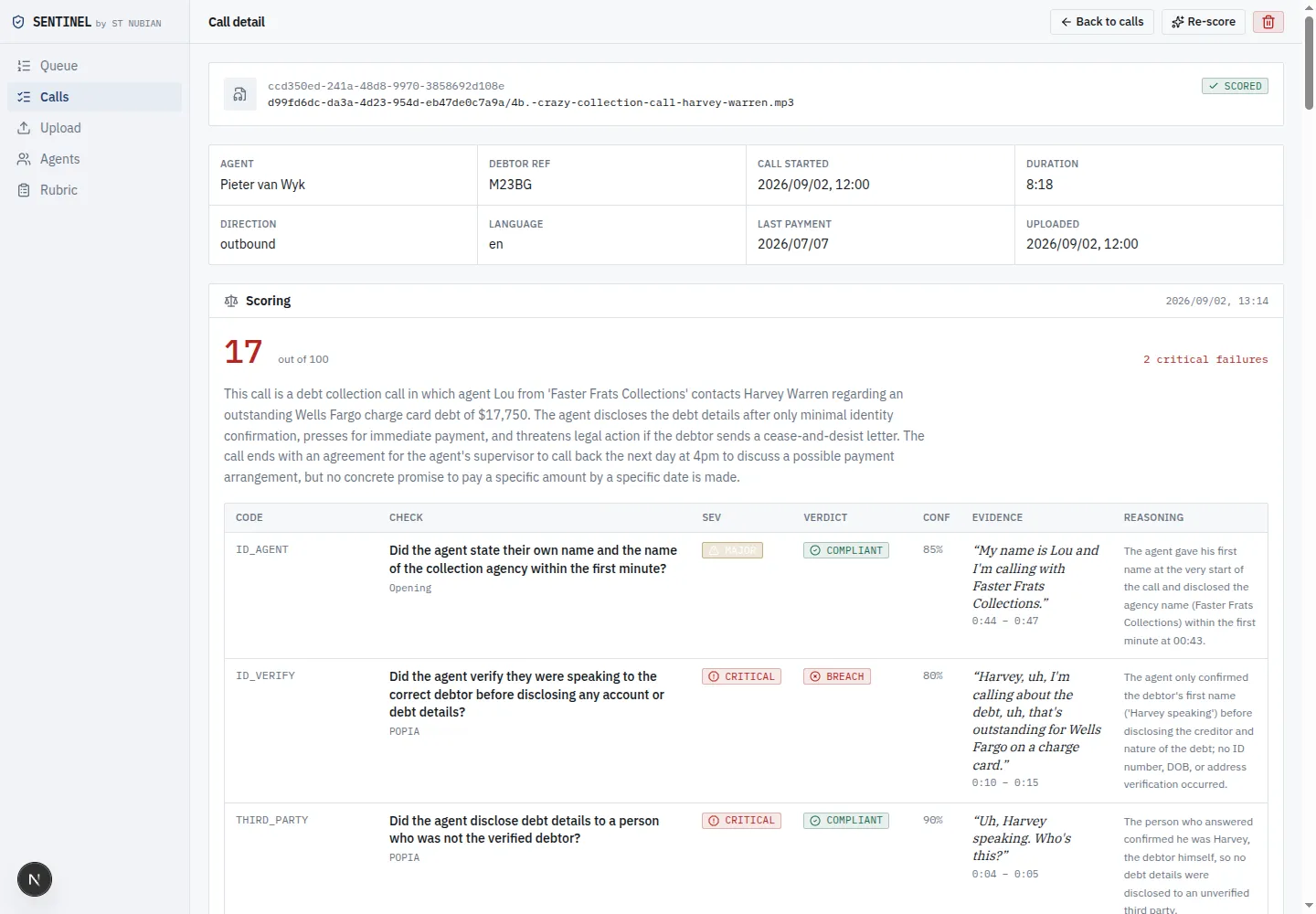
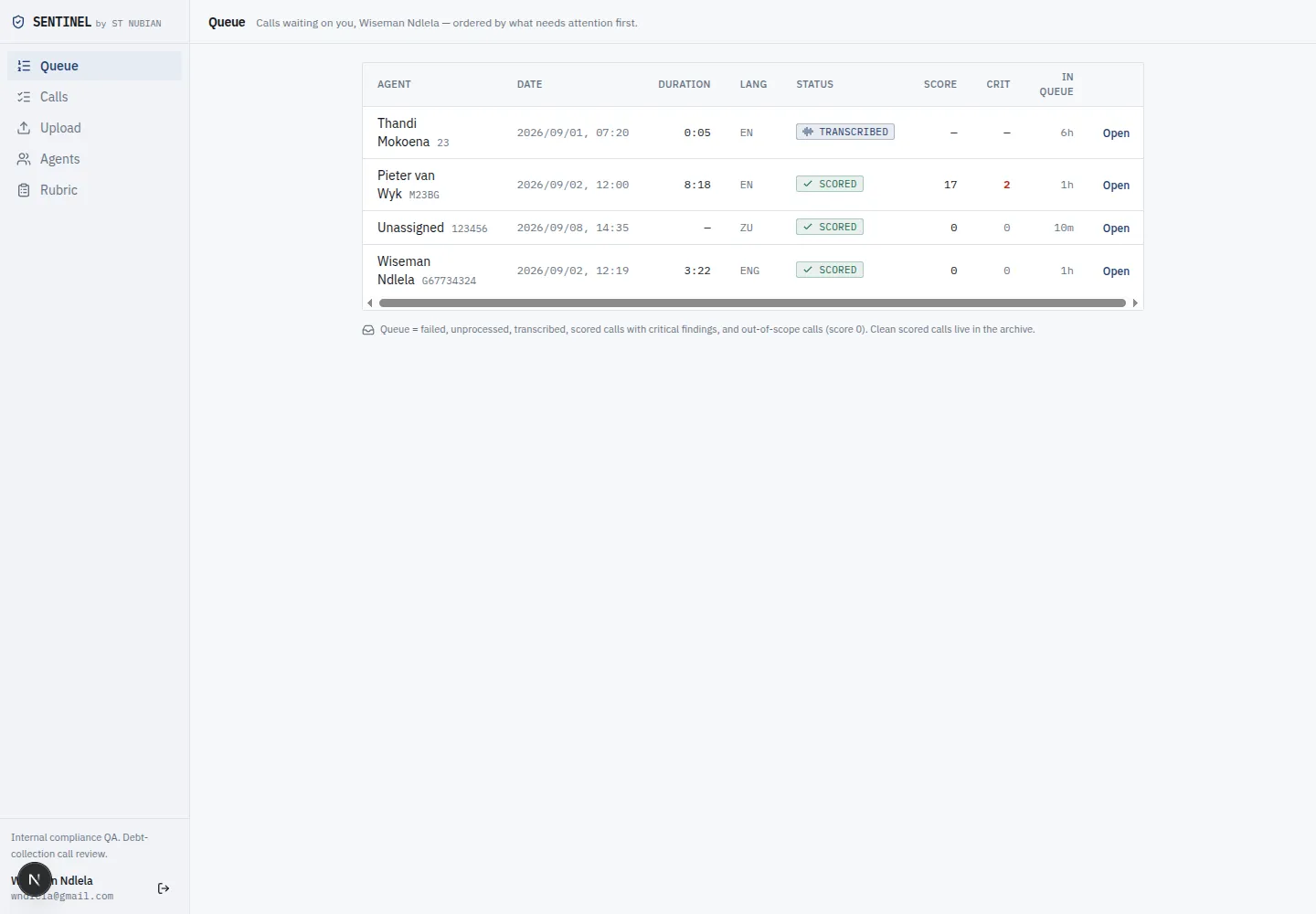
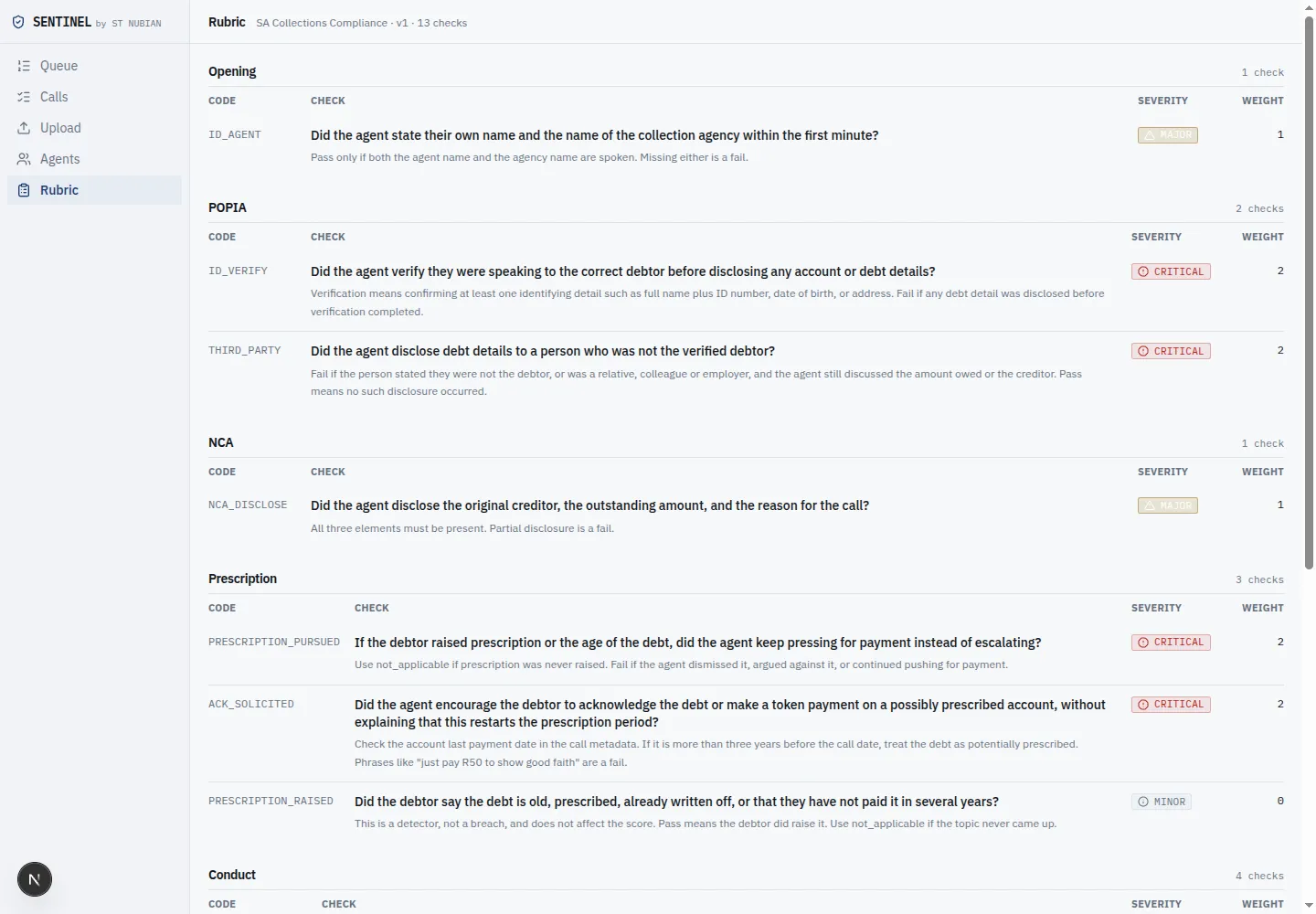
Screens shown with synthesised call data — no real debtor information appears anywhere in this product's marketing.
What Sentinel checks for, act by act.
These are the checks in the default rubric — a scoring checklist, not a statement of the full scope of any act. Your compliance policy is your counsel's job; Sentinel scores what you ask it to score.
National Credit Act
NCA_DISCLOSE — The original creditor, the outstanding amount and the reason for the call, disclosed.
PRESCRIPTION_RAISED — Whether the debtor said the debt is old, prescribed or already written off.
PRESCRIPTION_PURSUED — Whether the agent kept pressing for payment after the debtor raised prescription.
ACK_SOLICITED — Whether the agent pushed for an acknowledgement or token payment on a possibly prescribed account.
AFFORDABILITY — Whether the agent asked about the debtor’s financial circumstances before proposing an arrangement.
Debt Collectors Act
ID_AGENT — The agent’s own name and the agency name, stated within the first minute.
HARASSMENT — Threatening, abusive, intimidating or persistently badgering language.
MISREP_LEGAL — Misrepresentation of the legal consequences of non-payment.
DISPUTE_HANDLED — A dispute acknowledged, and the dispute process explained.
PTP_OBTAINED — A promise to pay with a specific amount and a specific date.
CLOSING — The agreed next step confirmed, with a reference, before the call ends.
POPIA
ID_VERIFY — The agent verified they were speaking to the correct debtor before disclosing anything.
THIRD_PARTY — Debt details disclosed to a person who was not the verified debtor.
Built for a POPIA audit, because yours is coming.
Sentinel operates as your operator under POPIA, with a signed operator agreement, defined retention periods, and a complete audit trail of every recording accessed, every export taken and every finding reviewed. Encryption in transit and at rest. Role-based access with agent-level restrictions. Hosting locations — including which processing stages happen outside South Africa — are disclosed in the operator agreement before you sign.
The security page is the short form; a more detailed security pack is available on request, before any commercial conversation.
POPIA operator status
Sentinel operates as your operator, under a signed operator agreement with defined retention periods.
Data residency
Hosting locations are disclosed in the operator agreement; some processing happens outside South Africa.
Encryption
In transit and at rest.
Access controls
Role-based, with agent-level restrictions on who can hear what.
Retention
Recording lifecycles defined by your policy, with deletion on termination.
Audit trail
Every review decision and appeal, recorded with actor and timestamp.
Three roles. The third one matters.
The compliance officer
Four to six hours a day in the review workspace, working a queue ordered by risk. Every finding arrives with the audio attached — confirming or overturning it takes seconds, not an afternoon of raw calls.
The team leader
The queue, ordered by risk: the calls that need a judgement first, the checks that failed, and the evidence to back the conversation.
The agent
Agents see their own scores, hear the audio behind every finding, and can appeal any one of them. Passed checks appear alongside failures. A QA system that agents believe is unfair is a QA system that gets quietly worked around, so Sentinel was designed to be defensible to the person being measured.
Questions compliance teams ask.
Does Sentinel integrate with our dialler?
Sentinel connects over SFTP or S3 and collects recordings on a schedule, typically overnight. No changes to your dialler, nothing for agents to learn. If your dialler exports call audio and metadata, Sentinel can ingest it.
How accurate is it?
Accuracy is measured against your own reviewers on your own calls — in the languages your floor actually uses. You judge the numbers yourself before you commit.
What happens on poor audio?
The system says so. Low-confidence findings are labelled and routed to a human lane rather than asserted.
Can agents appeal?
Yes. Every finding shows the audio and the reasoning behind it, and appeal is a first-class action. Passed checks appear alongside failures — a fair account of the call, not a list of accusations.
Where does the data live?
Hosting locations are disclosed in the operator agreement before you sign — including which processing stages happen outside South Africa. Sentinel operates as your POPIA operator under that agreement, with retention periods defined up front and an audit trail of every access.
How long does deployment take?
Plan for two to three weeks: dialler connection, encoding your QA scorecard into the rubric, and a calibration run against your reviewers. No hardware, no agents to retrain.
What happens to the recordings?
Retention follows your policy: recordings are deleted when retention expires or the agreement ends. Exports and playbacks are logged, so there is a record of every access.
See it score one of your calls.
Send us ten recordings and we will return a full compliance analysis of them within a week, before any commitment. You will learn something about your call floor either way.
Book a demoOr ask for our accuracy report on South African code-switched audio.